Microcurrent mode
Typically lower-intensity and often barely perceptible. Its cosmetic role is gentle facial stimulation supporting a temporarily toned, refreshed and defined appearance.
Two forms of electrical stimulation. Two distinct roles.
Combined thoughtfully, microcurrent and EMS can support the appearance of a more toned, defined and revitalized face—without heat, needles or recovery time.

Both use electrical pulses, but they are designed to create different levels and patterns of stimulation.
Microcurrent generally refers to very low-level current, often measured in microamperes. It is commonly faint or barely perceptible and is used for gentle facial stimulation and temporary visible toning.
EMS—electrical muscle stimulation, often described technically as NMES when it targets neuromuscular activation—uses pulses intended to activate motor nerves and create a more noticeable muscle response. Depending on the device and setting, this may feel like rhythmic pulsing or produce a visible contraction.
Neither modality is primarily a heat treatment or a deep ingredient-delivery system. Their role is electrical stimulation, delivered at different intensities and with different pulse characteristics.

A combined device can use microcurrent for subtle, comfortable stimulation and EMS for more direct neuromuscular activation. The modes may operate separately, sequentially or through different preset programs.
Typically lower-intensity and often barely perceptible. Its cosmetic role is gentle facial stimulation supporting a temporarily toned, refreshed and defined appearance.
Uses pulse characteristics intended to recruit motor nerves and activate facial muscles. The sensation is usually more noticeable and may include rhythmic pulsing or contraction.
The pairing allows one device to offer a subtle stimulation mode and a more active muscle-focused mode. The presence of both does not mean they are interchangeable or equally supported for every claim.
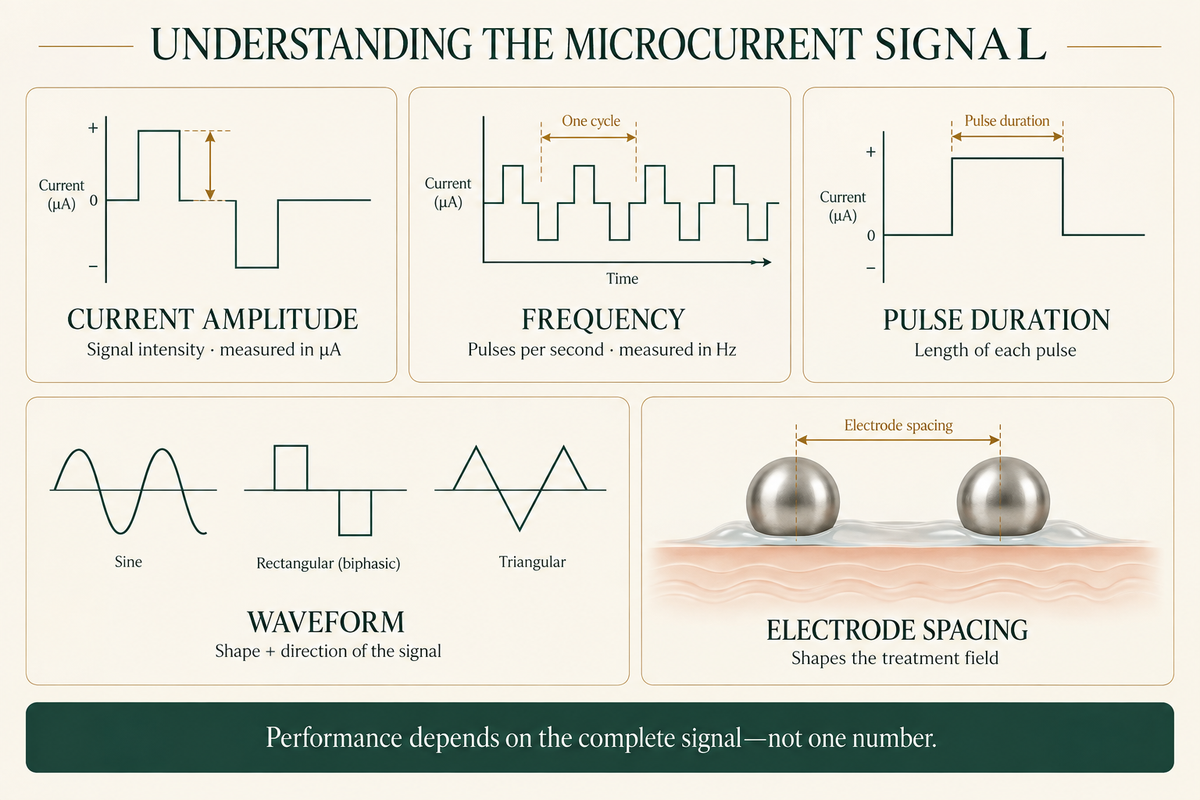
Amplitude, frequency, pulse duration, waveform, duty cycle and electrode placement determine the response. Program names alone reveal very little about actual performance.
Two devices labeled “microcurrent + EMS” may behave very differently. Amplitude, frequency, pulse duration, waveform, duty cycle, electrode geometry, conductivity and treatment time all help determine whether stimulation remains subtle or produces muscle activation.
Important: A visible contraction is more characteristic of EMS/NMES than of classic sub-sensory microcurrent. Higher intensity does not automatically mean a better cosmetic result.
| Technology | Primary characteristic | Typical sensation | Cosmetic role |
|---|---|---|---|
| Microcurrent | Very low-level electrical current, generally described in microamperes | Often faint or barely perceptible | Gentle facial stimulation and temporary visible toning |
| EMS / NMES | Pulses designed to activate motor nerves and elicit muscle response | Noticeable rhythmic pulsing; contraction may be visible | Facial muscle activation and temporary visible toning, depending on the device |
| Iontophoresis | Current assists movement of certain charged substances | Mild tingling may occur | Transdermal delivery in appropriately designed systems |
| Electroporation | Short pulses temporarily alter membrane permeability | Varies by device | Used in some ingredient-delivery systems |
| Radiofrequency | Alternating electrical energy generates controlled heat | Warmth | Thermal skin-treatment applications |
After an individual session, some users may see temporarily improved definition, a more refreshed appearance or smoother-looking skin from the conductive medium and device movement.
Repeated use of an appropriate microcurrent or EMS program may support visible facial tone and contour. Results vary, are not permanent and generally require maintenance.
Neither modality should be presented as a substitute for surgery, a method of fat reduction or a guarantee of permanent muscular or structural change.
Electrical stimulation is well established as a technology category, but cosmetic evidence for at-home facial devices remains limited and highly dependent on the exact system.
A randomized controlled trial of a facial NMES device reported improvements in several appearance measures and increased facial muscle thickness after twelve weeks of regular use. That evidence supports the tested NMES device and protocol; it should not be reassigned broadly to traditional microcurrent.
Microcurrent-specific facial research is more limited. Studies of combination devices may be informative, but their results cannot identify which modality produced which outcome. The most reliable claims are therefore tied to the finished device, its programmed output and the schedule actually studied.
The Proaging standard: identify whether a result comes from microcurrent, EMS/NMES or a combined system—and require evidence for the exact finished device.

A continuous conductive medium reduces resistance, distributes current more evenly and allows smooth movement without pulling the skin.
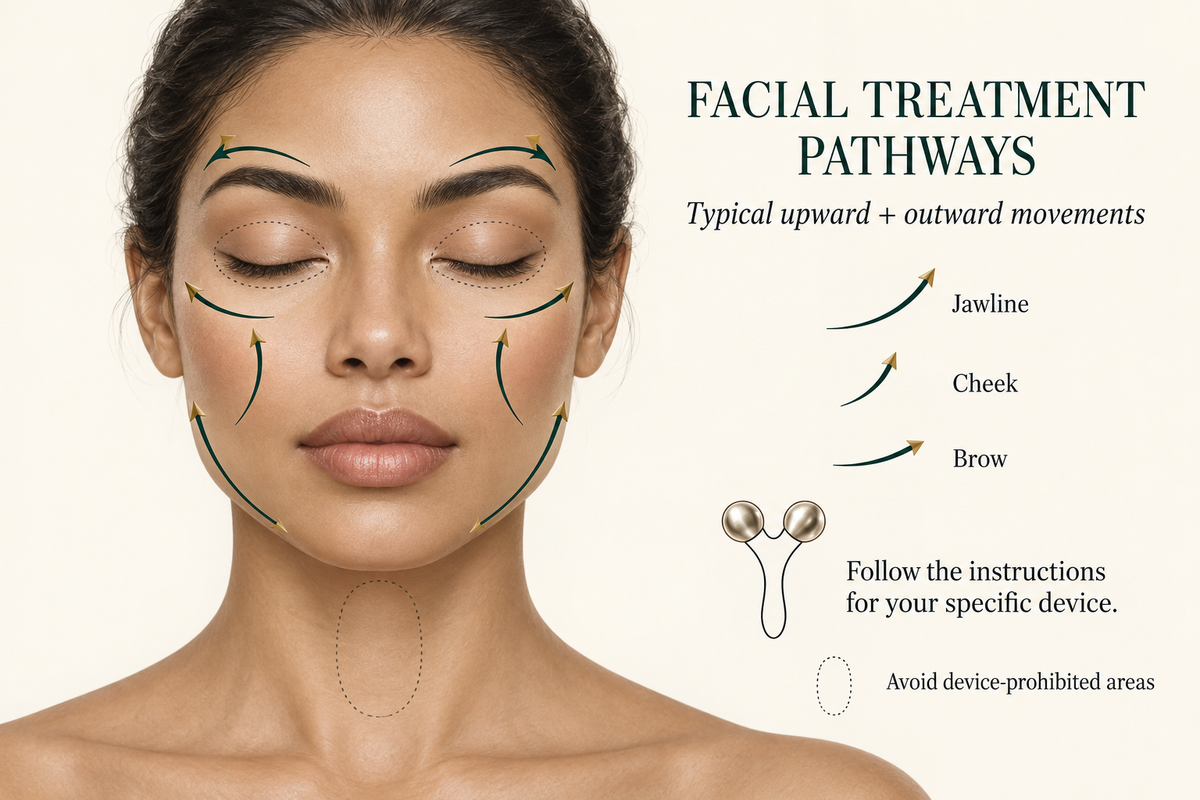
Confirm which mode you are using before every session. Microcurrent and EMS may require different intensity levels, placement, movement and treatment times.
Microcurrent: often faint or barely perceptible, although light tingling may occur.
EMS/NMES: more noticeable rhythmic pulsing, tapping or muscle contraction. It should remain controlled and tolerable—not painful.
Neither mode should feel hot or cause burning. Stop for persistent pain, sharp stinging, dizziness, visual disturbance or prolonged involuntary contraction.
A practical cue: prickling can indicate drying gel or incomplete contact. Strong contraction may be expected in an EMS program, but it is not evidence that a microcurrent program is “working better.”
A combined device may have different contraindications, intensity limits and placement rules for microcurrent and EMS. The exact labeling always takes precedence.
Stop treatment for pain, burning, prolonged redness, persistent spasms, dizziness, visual disturbance, skin injury or shock-like discomfort. This material is educational and does not replace advice from a qualified healthcare professional.
Microcurrent and EMS can complement one another, but their value lies in controlled, purposeful stimulation—not dramatic contractions or inflated promises.
We look beyond labels such as microcurrent, EMS, “sculpting” and “lifting.” We consider output, waveform, duty cycle, electrode geometry, conductive medium, safety, usability and evidence for the exact device.
A combined device is most credible when each modality has a defined role—and each claim can be traced to evidence.

The modalities can play complementary roles. Microcurrent provides very low-level stimulation and is often barely perceptible, while EMS/NMES is designed to activate motor nerves and create more noticeable muscle contraction. A combined device may use separate modes or a programmed sequence; the value depends on the exact output and protocol.
They may create a subtle, temporary lifted, toned or more defined appearance, particularly around the brows, cheeks and jawline. Results vary, and neither modality produces a surgical or permanent lift.
Some people notice a more defined or refreshed appearance immediately. More sustained visible results generally require regular use over several weeks and vary by device, technique and individual response.
No. Visible effects from both microcurrent and EMS are generally consistency-dependent and require continued use according to the manufacturer’s schedule.
Microcurrent is often faint or barely perceptible. EMS/NMES usually creates more noticeable pulsing or controlled muscle contraction. Neither mode should feel hot, sharp or painful.
Only if the manufacturer confirms it is suitable. Many serums dry too quickly or provide inadequate conductivity; oils can interfere with electrode contact.
Not necessarily. Conductivity alone does not establish meaningful delivery. Iontophoresis and electroporation are specifically designed to influence transport across skin.
No. Traditional microcurrent is generally lower intensity and may cause little perceptible contraction. EMS or NMES is designed to activate motor nerves and produce more noticeable contraction.
No. Microcurrent and EMS use electrical stimulation for different neuromuscular effects. Radiofrequency uses alternating electrical energy to generate controlled tissue heating.
Laboratory research has explored cellular responses to electrical stimulation, but universal collagen or dramatic ATP claims are not established for every home facial device. Such claims should be supported by research on the exact device and protocol.
Ask the treating professional and follow the device guidance. Use may need to pause around injectables, surgery, lasers, peels, microneedling or other procedures.
People with implanted electronic devices, seizure disorders, certain cardiac conditions, active cancer or suspicious lesions, recent surgery, impaired sensation, infection, open wounds, significant inflammation or pregnancy should seek appropriate guidance and follow device-specific contraindications.
Not necessarily. Microcurrent routines often use slow gliding movements, while EMS programs may specify fixed placements or timed holds. Follow the instructions for the selected mode rather than improvising.
Look beyond intensity and marketing claims. Consider intended use, regulatory status, separately disclosed output for each mode, waveform, duty cycle, electrode design, safety testing, contraindications, instructions, conductive-medium requirements and evidence for the finished device.
For those who want to look beyond marketing language, these regulatory and peer-reviewed resources provide useful context on electrical muscle stimulation, facial NMES research and the broader home-device category.
An accessible overview of EMS claims, device regulation and consumer safety considerations.
Read at FDA.gov → Randomized controlled trialA 12-week controlled study evaluating a specific neuromuscular electrical-stimulation device and protocol.
View on PubMed → Peer-reviewed reviewA broader review of home-use facial technologies, evidence, efficacy measures and safety considerations.
Read the full article → Controlled clinical studyAn eight-week split-face study examining facial skin and appearance outcomes from a defined fNMES protocol.
View on PubMed →External research is provided for education. Findings from one device, waveform or protocol should not be assumed to apply to every microcurrent or EMS product.
Distinct modes. Controlled output. A ritual designed for consistency.
Shop Electrical Stimulation Devices